I have personally run through dozens of security audits for organizations ranging from early-stage startups to mid-market SaaS platforms. One question always comes up first: which type of penetration testing do we actually need? It sounds simple. However, choosing the wrong method wastes budget, misses critical vulnerabilities, and gives leadership a false sense of security. This guide breaks down every penetration testing type, how each one works, and when to use it — based on real-world experience and the latest 2026 market data.
What Is Penetration Testing and Why Does It Matter in 2026
Penetration testing is the practice of simulating real-world cyberattacks on your own systems — with permission — to find exploitable weaknesses before attackers do. It goes far beyond running automated scans. A skilled tester thinks and acts like a threat actor, chaining vulnerabilities together to demonstrate actual impact.
The numbers make the case clearly. The penetration testing market is projected to expand from USD 2.72 billion in 2026 to USD 5.54 billion by 2031, registering a CAGR of 15.29%. Meanwhile, IBM reported a global average data breach cost of $4.4 million in its 2025 Cost of a Data Breach report, which organizations frequently cite to justify offensive testing budgets.
Furthermore, compliance is now a major forcing function. Mandatory annual tests under HIPAA and PCI DSS version 4.0, along with the EU’s Digital Operational Resilience Act and NIS2, have shortened internal decision cycles and lifted multi-year contract values.
If you are exploring cybersecurity as a career path, our guide on how to become a hacker covers the foundational skills that underpin every pen testing discipline.
The Three Core Knowledge-Based Penetration Testing Types
Before diving into specific test categories, every penetration test falls into one of three knowledge-based approaches. Understanding these first makes every other classification easier.
Black Box Penetration Testing
In a black box test, the tester receives zero prior knowledge about the target environment. No architecture diagrams, no credentials, no source code. The engagement simulates a completely external attacker who has done nothing but passive reconnaissance.
This approach is the most realistic representation of a real-world attack. It is therefore ideal for organizations wanting to know exactly what an opportunistic threat actor would find. However, it is also the most time-intensive and expensive option. Testers spend significant hours on reconnaissance that internal teams could otherwise skip.
The white box global penetration testing market is expected to reach $4.57 billion globally by 2028, growing at a CAGR of 14.6%, which suggests organizations increasingly combine knowledge-based approaches rather than relying on black box alone.
White Box Penetration Testing
White box testing — also called crystal box or clear box testing — provides testers with complete internal access. This includes source code, network architecture, credentials, and system documentation. Consequently, testers can probe much deeper into application logic, backend systems, and infrastructure configuration.
This method is most effective for code-level vulnerability discovery, internal audits, and pre-launch assessments of new applications. Moreover, it delivers the highest coverage for the time invested. The tradeoff is that it does not replicate the perspective of an external attacker. Therefore, many organizations pair it with a black box engagement on different systems.
Grey Box Penetration Testing
Grey box testing sits between the two extremes. Testers receive partial information — perhaps a user account, limited documentation, or basic network diagrams — simulating someone with limited inside knowledge such as a contractor or recently hired employee.
The grey box global penetration testing market worldwide is expected to reach $1.73 billion by 2028, growing at a CAGR of 12.4%. This approach balances depth and realism, making it the most popular choice for organizations running periodic assessments on established environments.
For a deeper dive into how these testing philosophies connect to broader security strategy, read our full breakdown of penetration testing types on Upstanding Hackers.
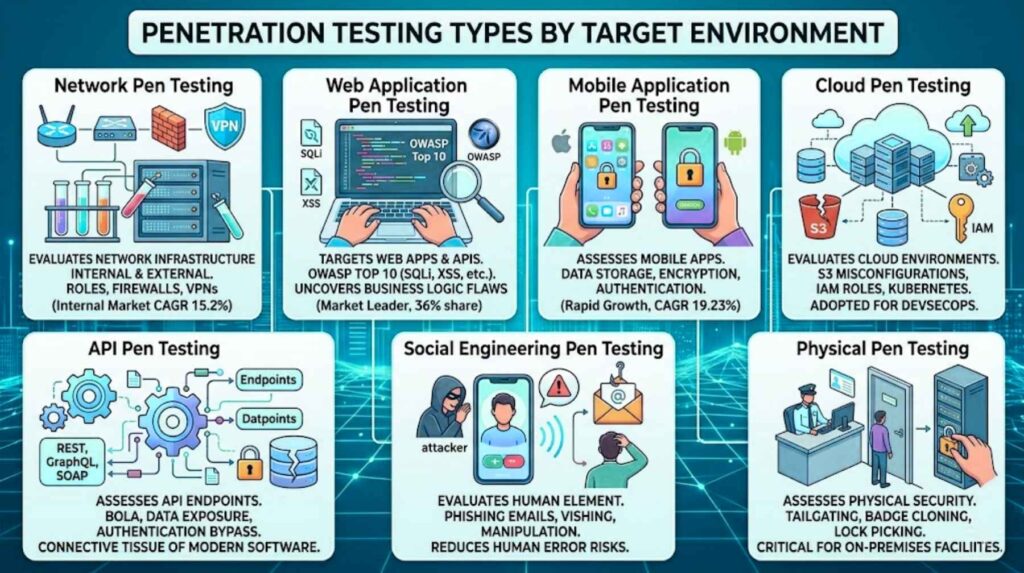
Penetration Testing Types by Target Environment
Once the knowledge model is decided, organizations must choose which environment or attack surface to test. Each type targets a distinct layer of the technology stack.
Network Penetration Testing
Network pen testing evaluates the security of an organization’s internal and external network infrastructure. Testers probe routers, switches, firewalls, VPNs, and exposed services for misconfigurations, unpatched software, and weak credentials.
This is traditionally the most common form of engagement. Core Security’s survey found that network security tests were among the most common program additions, included at 36% of organizations expanding their scope.
Network testing further divides into internal and external categories. Internal network testing assumes the attacker is already inside the perimeter — simulating a compromised workstation or a malicious insider. External network testing, conversely, attacks from the internet boundary inward. The internal network pen testing market is anticipated to grow at a CAGR of 15.2% during 2021–2026.
To understand how network security functions in cloud environments specifically, our article on network security in cloud computing is an essential companion read.
Web Application Penetration Testing
Web application testing is currently the largest segment of the pen testing market. Web application testing leads the market with a 36% share, driven by e-commerce platforms, SaaS solutions, and online portals where sensitive customer data and financial transactions occur.
Testers target vulnerabilities mapped to the OWASP Top 10, which includes SQL injection, cross-site scripting (XSS), broken access control, and insecure API endpoints. Additionally, they assess authentication flows, session management, and business logic flaws that automated scanners consistently miss.
Manual testing uncovered nearly 2,000 times more unique vulnerabilities than automated scans, which is why human-led web application assessments remain irreplaceable despite advances in automation.
Mobile Application Penetration Testing
As banking, healthcare, and retail continue migrating core workflows to mobile, this segment is accelerating rapidly. Mobile penetration testing is experiencing rapid growth with a CAGR of 19.23%, addressing issues like insecure data storage, weak encryption, broken authentication flows, and platform-specific threats on iOS and Android devices.
Testing is typically split across two platforms. iOS assessments focus on data protection APIs, keychain security, and jailbreak bypass risks. Android testing prioritizes intent hijacking, insecure broadcast receivers, and rooting scenarios. Both platforms share common concerns around hardcoded credentials, unencrypted local storage, and insecure network communication.
Cloud Penetration Testing
Cloud environments introduce entirely new attack surfaces that traditional network testing does not cover. Misconfigurations in S3 buckets, overpermissioned IAM roles, exposed Kubernetes dashboards, and insecure serverless functions are among the most frequently exploited weaknesses.
Cloud and API testing adoption is increasing steadily due to DevSecOps practices, microservices architecture, and hybrid cloud deployments. Furthermore, rapid adoption of cloud workloads and a sharp rise in generative AI-driven exploits are moving penetration testing from ad-hoc audits to always-on controls.
Our pillar article on AI in cybersecurity covers how AI is reshaping both attacker capabilities and defensive cloud testing approaches.
API Penetration Testing
APIs are the connective tissue of modern software — and therefore a prime attack target. API testing goes beyond web application testing to evaluate REST, GraphQL, and SOAP endpoints for broken object-level authorization (BOLA), excessive data exposure, mass assignment vulnerabilities, and authentication bypass.
As microservices architectures proliferate, the number of internal API endpoints grows exponentially. Consequently, many organizations discover that their most sensitive data is exposed not through the front-end interface but through undocumented or legacy API routes.
Social Engineering Penetration Testing
Technical controls are only as strong as the humans operating them. Social engineering tests evaluate how well employees resist manipulation tactics including phishing emails, vishing (voice phishing) calls, pretexting scenarios, and physical intrusion attempts.
Core Security’s survey found that phishing campaigns and social engineering tests were added by 30% of organizations expanding their pen testing programs. This reflects growing recognition that human error remains the leading initial access vector in most breaches.
Our in-depth guide on how to spot phishing emails covers the defender-side perspective that complements understanding what social engineering tests actually simulate. Additionally, for teams wanting to automate detection, our article on building an AI phishing detector demonstrates practical no-code solutions.
Physical Penetration Testing
Physical pen testing is often overlooked but critically important for organizations with sensitive on-premises infrastructure. Testers attempt to bypass physical access controls — tailgating, badge cloning, lock picking, or social engineering reception staff — to gain access to server rooms, workstations, or network access points.
This type is particularly relevant for financial institutions, data centers, government facilities, and healthcare organizations where physical access to a single device could enable a catastrophic breach.
Specialized Penetration Testing Approaches
Beyond environment-specific tests, several specialized methodologies deserve attention.
Red Team Assessments
A red team engagement is not a penetration test in the traditional sense — it is a full adversarial simulation. Red teams operate with a specific objective (steal this data, compromise this executive’s workstation, achieve domain admin) and use every available tactic, technique, and procedure (TTP) to reach it.
Red teaming is typically longer (weeks to months), more covert, and more expensive than standard pen tests. However, it provides an unmatched view of how well an organization’s entire security program — people, processes, and technology — would hold up against a determined, sophisticated threat actor.
Purple Team Testing
Purple teaming is a collaborative approach where offensive (red) and defensive (blue) teams work together in real time. Rather than the red team operating covertly, both sides share information continuously. This accelerates learning, improves detection rule tuning, and builds internal security capability faster than traditional red team engagements alone.
Automated Penetration Testing (PTaaS)
Penetration Testing as a Service (PTaaS) platforms combine continuous automated scanning with on-demand human expertise. Security leaders no longer view penetration tests as one-off engagements ending with a PDF — they expect timely, actionable results that feed into broader vulnerability management and remediation programs.
PTaaS solutions integrate directly into CI/CD pipelines, enabling developers to trigger tests at every code commit. This approach dramatically reduces the gap between vulnerability introduction and discovery. For a detailed comparison of low-cost automation options, see our guide on low-cost AI agents for small business workflows.
Penetration Testing Types: Quick Comparison Data Table
| Test Type | Knowledge Level | Primary Target | Best For | Avg. Engagement Length |
|---|---|---|---|---|
| Black Box | None | External surface | Realistic attacker simulation | 1–3 weeks |
| White Box | Full | Code & architecture | Code audits, pre-launch | 1–2 weeks |
| Grey Box | Partial | Mixed | Periodic security assessments | 1–2 weeks |
| Network (External) | None/Partial | Perimeter systems | Internet-facing infrastructure | 1 week |
| Network (Internal) | Partial/Full | Internal systems | Insider threat simulation | 1–2 weeks |
| Web Application | Partial/Full | Web apps | OWASP Top 10 coverage | 1–3 weeks |
| Mobile Application | Partial | iOS/Android apps | Mobile security compliance | 1–2 weeks |
| Cloud | Partial/Full | Cloud infra | Misconfiguration discovery | 1–2 weeks |
| API | Partial/Full | API endpoints | Microservices security | 1 week |
| Social Engineering | None | Human layer | Phishing resistance, insider risk | 1–4 weeks |
| Physical | None | Physical access | On-premises security | Days–1 week |
| Red Team | None | Full organization | Mature security programs | 4–12 weeks |
How to Choose the Right Penetration Testing Type
Selecting the right test starts with answering four questions.
First, what is your primary attack surface? A SaaS company with no physical premises and all cloud infrastructure needs a very different test than a manufacturing facility with both OT networks and corporate IT.
Second, what is your compliance requirement? PCI DSS 4.0 mandates specific network and application testing. HIPAA requires regular risk assessments. NIS2 and DORA in Europe mandate broader scope. Compliance requirements often dictate the minimum testing scope you must achieve.
Third, how mature is your security program? Organizations with immature security posture benefit most from network and web application tests. More mature programs gain greater value from red team engagements and purple teaming.
Fourth, what is your budget? One in three companies cites budget as their reason for not conducting tests more frequently. A phased approach — starting with the highest-risk surfaces and expanding over time — is more effective than a single large engagement every few years.
For context on how AI is now actively assisting both attackers and defenders in this space, our detailed guide on whether cybersecurity can be done by AI is a must-read before finalizing your testing strategy.
Additionally, our comprehensive coverage of threat intelligence explains how threat intelligence feeds should inform which pen testing types you prioritize.
The Growing Role of AI in Penetration Testing
AI is transforming penetration testing from both sides of the equation. Attackers now use AI to generate convincing spear phishing content, automate vulnerability scanning, and identify attack paths faster than ever. Public exploit kits now appear within hours of vulnerability disclosure, shrinking defenders’ reaction windows and forcing more frequent penetration tests.
On the defensive side, AI-assisted pen testing tools can now generate attack chains, prioritize findings by business impact, and even suggest remediation steps. However, experienced human testers remain essential for business logic flaws, creative attack chaining, and nuanced social engineering scenarios that automated tools consistently fail to replicate.
For organizations wanting to understand how AI intersects with the broader cybersecurity landscape, our AI augmenting humans article provides important strategic context.
Penetration Testing and Regulatory Compliance
Compliance mandates are now among the strongest drivers of pen testing adoption globally. BFSI commanded 28.68% of penetration testing market share in 2025, and healthcare and life sciences are projected to expand at a 16.89% CAGR during 2026–2031 — both sectors driven heavily by regulatory requirements.
Key compliance frameworks that mandate or strongly recommend penetration testing include PCI DSS (payment card industry), HIPAA (healthcare), SOC 2 (cloud service providers), ISO 27001 (information security management), NIST 800-115 (federal agencies), and DORA/NIS2 (EU financial and critical infrastructure).
For organizations managing cybersecurity across multiple compliance requirements, our best cybersecurity companies guide identifies the leading vendors offering compliance-aligned pen testing services.
Frequently Asked Questions

What is the most common type of penetration testing in 2026?
Web application penetration testing is currently the most common type, holding a 36% market share driven by e-commerce platforms, SaaS solutions, and online portals handling sensitive data. Network penetration testing remains a close second, particularly for organizations with significant on-premises infrastructure.
What is the difference between a vulnerability assessment and a penetration test?
A vulnerability assessment identifies and catalogues potential weaknesses using automated scanning tools. A penetration test goes further — a skilled tester actively attempts to exploit those vulnerabilities, chain them together, and demonstrate real-world impact. Vulnerability assessments tell you what might be broken. Penetration tests show you what is broken and what an attacker could actually achieve.
How often should organizations conduct penetration tests?
Most compliance frameworks recommend at minimum annual testing. However, best practice in 2026 is more frequent. Organizations should test after significant infrastructure changes, major application releases, mergers or acquisitions, and any security incident. Verizon’s median remediation time of 32 days for perimeter vulnerabilities supports a practical workflow where major changes trigger targeted retesting.
What is the difference between a red team and a penetration test?
A penetration test is scoped, time-limited, and focused on finding as many vulnerabilities as possible within a defined target. A red team engagement is objective-based, covert, longer in duration, and designed to test the entire security program — technology, people, and processes — against a realistic, persistent adversary scenario.
Can small businesses benefit from penetration testing?
Absolutely. Over 87% of all critical and high penetration test findings are found in organizations with under 200 employees, suggesting small businesses carry disproportionately high risk. PTaaS platforms and focused, scoped web application tests make professional pen testing accessible at price points suited to smaller budgets. For additional cost-effective security tools, see our guide on cybersecurity for small business.
Final Thoughts
Penetration testing is not a checkbox exercise. It is one of the most effective investments an organization can make in its actual security posture. The key is choosing the right type for your environment, budget, and risk profile — and then acting on what the test reveals.
Start with the surfaces most likely to be targeted: your web applications, external network perimeter, and the humans on your team. Then expand scope over time as your security program matures. Furthermore, as AI-driven threats accelerate the pace of exploitation, organizations that treat proactive validation as essential insurance will be far better positioned against vulnerabilities weaponized within hours of public disclosure.